|
League Rules Fast Pitch Rules COWL Playoff Rules FLAG Football Rules
Section I - COWL Special League Rules Return to Top
Central Ohio Wiffleball League Rules (our Goldstick rules)
This is a family friendly environment
Profanity and alcohol are strictly prohibited
Tournament rules differences are noted in this color print.
THESE RULES ARE "SPECIAL" LEAGUE RULES AND DO NOT APPLY TO TOURNAMENTS : a) to the opposing team b) BEFORE the game begins. The DRP applies to every game in the current series and may NOT be changed once the series has started. A different DRP may be chosen for each series. Saves will now be recorded as an official stat.
IF a DRP is indicated, these rules apply : - All players on the team with a DRP get 4 innings pitching per series. - The DRP can pitch ANY inning after the 4th inning, including extra innings. - The DRP MUST pitch ALL extra innings (no relief for him). - The DRP can relieve the starting pitcher after 1 out in the 1st inning. - Only DRPs can relieve the starting pitcher before the 2nd inning. - When a DRP relieves before the 3rd inning, the DRP can only pitch until the start of the 3rd inning - an no further relief is permitted by the DRP - unless the game enters extra innings - which the DRP MUST pitch (ALL extra innings - as above). - A "Save" happens anytime the DRP pitches in a game in the 4th, 5th or extra innings and his team wins the game (unless the DRP is the winning pitcher). IF NO DRP is indicated, these rules apply : - All players on the team with NO DRP get 5 innings pitching per series. - The starting pitcher MUST pitch the 1st and 2nd innings - with NO relief possible. - Extra innings count toward the innings pitched count IN EITHER case, these rules apply : - The pitcher who records 2 outs in a inning owns the inning. - If no pitcher records 2 outs, the pitcher who records the last out owns the inning. - The innings available for all players reset ONLY AFTER all innings for EACH player have been used up (choose wisely grasshopper). - To Ensure accuracy you should record your opponents innings pitched ! For tournaments, any player is permitted to throw any number of innings with no restrictions. pitch, and at the release of a pitch. If any part of either foot is not, an automatic ball results. To retire a runner out with pitcher's hand a portion of both of the pitchers feet must in contact with the pitching circle - i.e., pitchers cannot "stretch" for balls with one foot off of the pitching circle. With the advantage going to the defense, in addition to pitcher's hand, the defense has enough advantage without allowing the pitcher to stretch from the pitcher's mound. Pitcher's hand will only retire the runner GOING TO, or RETURNING TO, 1st base. All other base runners must be retired in the normal manner, i.e., force, tagging, pegging, etc. They may not be stuffed or altered in any way other than listed below. Bats may have tape on the handle and may be painted with spray paint. Only regulation Wiffle bats are permitted. No foreign substances are permitted on the bat except as noted.
Using an altered bat will result in all runs for the offending team to that point in the game being nullified (i.e., start back at 0 runs) at that point in the game. Section II - COWL Regular League Rules Return to Top
Major League Baseball rules will be adhered to with thefollowing exceptions:1. Sportsmanship - All teams engaging in unsportsmanlike conduct will be removed from the game IMMEDIATELY at the discretion of the commissioners !
ABSOLUTELY NO ALCOHOL PERMITTED UNDER ANY CIRCUMSTANCES !!
A base runner must be completely past the bag (both feet off) to be safe. This eliminates judgement calls related to beating throws out. Wiffle ball is a hitter's game - hit it farther or to a better spot so close plays do not occur. We will do our best to be on top of calls, and umpires will be paying attention and know the rules - but we still may miss some. For league games teams will umpire their own games. If an irresolvable call on a close play occurs - the play will be repeated, commonly known in backyard language as a "do over". Please keep the the arguing to a minimum. This is, after all, Wiffle ball. 3. Equipment - All bats used in league play must be regulation, yellow WIFFLE bats. They may not be stuffed or altered in any way other than listed below. Bats may have tape on the handle and may be painted with spray paint. Only regulation Wiffle bats are permitted. No foreign substances are permitted on the bat except as noted. Balls will be official WIFFLE balls, those with holes for adults and solid Wiffle balls for youth (12 and under) and ladies. Youth wishing to hit solid wiffle balls must supply a birth certificate to prove age. We will trust the ladies. For tournaments play, only regular Wiffle balls, i.e., the kind with holes, will be used. WILL NOT be permitted to play due to safety concerns (ouch on my toes) and the damage they do to batters boxes. Coaches please tell your players about the cleat rule ! of players and players may be added at any time (we are easy). However, a player can only play for one team in a season, unless a special dispensation is given by ALL Commissioners, and they are likely to enact a heavy toll in indulgences. Each team shall have at least 3 players on the field to compete. Players may be added to the roster at any time, but must play in 1/3 of a season's games or at least 2 complete series to be eligible for post season play. All players must sign the waiver release form before playing any games in a season. forfeit any games until able to field at least 3 players from the original roster. Three player teams are permitted. Players may be added to the roster, provided they sign the release waiver form, at any time. Players may exist on only 1 roster at a time. Players may switch teams upon approval by all 3 Commissioners. players defensively throughout the game, (especially on 5-6 player rosters). Players arriving after the start of a game will automatically be placed at the bottom of the lineup but need not play the field before being able to bat. However, they must be placed at the bottom of the lineup as the original order may not be altered. Aside from inserting a batter at the bottom of the lineup, the batting order cannot be changed at any time during the game. All those who begin, must end, or an out will be taken at their position in the batting order every time they would have batted.
on your team. (Example your DH could bat for your pitcher for the entire game.) Also you can bat 3, 4, 5, or 6 players on your roster at any given time but you must stay with the same batting lineup throughout the game. Defensive players may be subbed in and out of the field at any time, but the batting order must stay the same. New players can be inserted at any time in a game, although they automatically bat after the last batter in the lineup. In the case of injury, a new player may be substituted in the injured player's place in the lineup, or the place may be skipped and an out taken each time. Sidearm pitching will not be permitted. The ball must be released with less than a 30 degree angle from the torso (no sidearm pitches). Balks are legal. Pitchers must start each pitch, and end each pitch, with both feet on the pitching mound. The legal arc range for strikes is above the top of the noodle and 10 feet. A minimum arch indicator will be present in the ground approximately 5' in front of home plate for slow pitch (underhand) games. Any pitched ball which does not exceed the height of the indicator (a rigid pool noodle) will be called flat and be a ball. The strike zone is the foam cushion behind home plate. Balls meeting arc criteria that hit the cushion in the air at any point on the cushion are strikes. Flat Pitches (under the arch indicating pool noodle) are flat and automatic balls. If an umpire is present he will call flat pitches as soon as possible but these pitches are still legal to be swung at and / or hit by the batter. If the batter does not swing at a flat pitch it is an automatic ball. Flat pitches swung at by batters can be hit normally and result in strikes if the ball goes foul or is missed on the swing. Again, any pitch which exceeds the arch indicator (pool noodle) in height and has been delivered underhand can be a strike (assuming it does not exceed the 10' pitch height maximum). Both fair and foul balls are live when a batter swings at a flat, excessive arch or illegal pitches and strikes result when foul balls and misses occur after a pitch is denoted as above. Pitches denoted as flat, excessive arch or illegal are automatic balls unless they are swung at. until the pitch is released. Failure to do so will result in an automatic ball. Having a ball in both hands when a pitch is delivered will result in an illegal pitch being called by the umpire (automatic ball resulting). REMEMBER : innings pitched will be recorded by you for your opponent ! inning restrictions. where upon a double will be awarded to the batter. If the batter chooses to continue to bat and 4 more balls are thrown an automatic home run will be awarded. You can pitch any way you want within the rules, but this Wiffle ball the wide open way is a hitter's game and so there will be a penalty for not throwing strikes and pitches which can be hit. We have found this levels the playing field, dramatically speeds play and makes it more enjoyable for all. Wiffle ball the Wide Open way is intended to be a hitting and fielding game.. Requiring pitchers to throw strikes, hence hittable pitches, facilitates this objective. Batters may strike out swinging or by called 3rd strike. Batters may choose not to swing at any pitch. Batters may swing one or two handed. Hit batters do not receive walks. A batter's box will be provided. All batters must begin with both feet completely in the box. The ball cannot be pitched until the batter has both feet in the box. Once the batter has both feet in the box the pitcher may pitch. If both of a batter's feet are outside the box at contact time, the batter is automatically out. Batters are not permitted to catch pitches. All pitches must be permitted to land (those curvy rascals). A batter catching a pitch results in an automatic strike on the batter, unless the pitch is so far out of the strike zone that both batter and pitcher acknowledge it. batter 6 balls at which time the batter can choose to take the automatic double or start with the count 6-0 and attempt to hit or receive 4 more balls for an automatic home run. Runners to 2nd, 3rd and home must be retired via normal means (stepping on the base, tagging or pegging). All ties and close plays are given to the defense. If a runner is not entirely past the base, (both feet off) and not obviously, without question safe, the runner is out. NOTE : at 1st base this rule applies to pegs, forces and tags - the runner must be ALL the way off the base before a tag, peg or force occurs or they are out. Again, if a runner is not entirely past 1st base, at the point of pitcher's hand, peg, tag or force, the runner is OUT. Runners may be tagged out at any bases and forces can be recorded by stepping on bases. the runner) and throws the ball to the pitcher on pitcher's plate = double play, as long as the throw to the pitcher beats the runner to first. If the shortstop simply throws the ball to the pitcher on the pitcher's plate, the runner to 1st is out. plays must be made with both feet in contact with the pitcher's plate (as per 1st base). Not being in contact with the pitcher's plate will result in all runners being called safe (treat the pitcher's plate as the lead base). pops can dance around, there is no "safe" pop-up. Base runners should run everything out, not be lazy, and not assume balls will be caught. Teams may drop pop flies on purpose. If the base runner runs the play out as they should no extra runners will be out. Of course, if the defending team first throws the ball to the mound for pitcher's hand then the force play is eliminated and the base runners do not need to advance. But to avoid confusion, base runners should run hits out (just like your Little League coach said). 12. Stealing or Leading Off - Base runners may not lead off from any base. Nor may they steal at any time. Runners may leave their base only after the batter makes contact with the ball. Leaving early will result in the runner automatically being called out, dead ball, replay pitch. Don't jump off the base, wait until it is hit. whether by bounce or ricochet will be out. Runners can be tagged out at any base and force plays can be made by stepping on the base, per normal baseball rules. Runners must stay in the baseline but can take evasive maneuvers, with the exception of diving, sliding or falling to the ground. This includes diving back to a base which has been over ran. Runners who dive back are out. No limit exists for home runs per team or individual. Hit as many dingers as you can ! *** This rule has been modified by the handicapped league format. AA teams are restricted to 3 HRs per game and AAA teams are restricted to 6 HRs per game. Major League teams are entitled to as many HRs as they can hit.
fence (by jumping, falling, sliding or leaning) will result in automatic home runs or dead ball fouls for the batter, regardless if the ball is batted back in, caught or uncaught. The bottom line is fielders must stay totally in the field of play or the batter is awarded with a home run. Foul balls in which a fielder touches any part of the out-of-play area by going over or under (sliding) the safety fence results in a dead ball (foul) regardless of if the ball is caught. If a ball is caught and carried out of play, or any portion of the fielder touches the out-of-play area, the ball is considered a dead ball foul - the batter is NOT out and all base runners advance 1 base ! Home Runs which are caught but result in the fielder leaving the field of play (falling over or running thru the fence) result in a HR for the batter - with NO out being recorded ! Successfully fielded balls require the fielder to remain totally in bounds, regardless of where the ball ends up.
game will be over. to make plays in fair territory. Doing so results in a dead ball, all runners advance 1 base safely call. Four fielders in fair play are permitted. Foul play extends to the bunt line located 12 feet in front of the plate. Catchers may go all the way up to the bunt line in fair play (but not past) and may catch foul balls for outs. At pitch time Catchers must be located be in foul territory, behind the 12' foul line extended. Catchers may peg any base runner as long as the catcher remains in legal guarding areas (foul territory). Catchers may retrieve any ball at any location in foul territory with no penalty. Catchers may not interfere with a ball in fair play in any manner (reaching over the foul line into fair territory) - either on batted balls or thrown balls. Contact with a ball in fair territory by a Catcher results in an automatic dead ball - all runners advance 1 base from the last base touched. 19. Sliding or Diving - Their will be no sliding or diving by offensive players into any base. Runners doing so will be called OUT automatically. If a runner over runs a base, they may not fall or dive back to the base. Doing so will be an automatic out. Unless a runner accidentally slips and falls they must reach the base upright or the runner will immediately be called out. own risk. the defense. Runners may advance at their own risk. Throws terminating in out of bounds areas (beyond the safety fence) automatically result in each base runner being awarded 2 bases from the last base achieved before throw was made. Example: peg is attempted on runner going to 1st, ball ends up beyond out of bounds safety fence = runner gets 1st and 2nd base. can catch it, the batter is out, as long as no portion of the fielder touches the out-of-play area (over or under). Batters receive as many fall balls as needed. The dead ball area is located 12' in front of home plate. Balls not touching foul territory (grounders) contacted by a player in fair territory (not having touched foul territory) are considered fair balls. Balls touching foul territory (grounders) contacted by a defender are considered foul regardless of where the defender is. Balls which have not contacted foul territory yet (fly balls) are totally dependent upon the position of the fielder, i.e., if the fielder is in fair territory (both feet have not touched foul territory) the ball is considered fair. If both feet of the defender have contacted foul territory and not touched back in fair territory the ball is considered foul. In summary, if the ball touches the ground in foul territory and is then touched by a defender, it is a foul ball. If it has not touched foul territory (still in the air) the position of the player contacting it determines its position. If the player has not totally established position in foul territory (both feet touching foul territory) the ball is considered fair. 22. Umpires- Tournament games will be umpired by someone who knows the rules and will pay attention. For league play, teams will self-umpire with irreconcilable calls resulting in a repeat of the play. League tournament play for the Divisional Championship playoffs and the World Series will be umpired by a supplied umpire, from the opposite division in the case of the Divisional series, unless both team Captains agree to suspend this rule. 23. Home Fields - For league play, teams sponsoring fields will be permitted to pick their home field and will automatically have series home field advantage (home-away-home) against regular non field sponsoring teams. When both teams in a series have sponsored fields, games will be played on a neutral field with a coin flip determining who gets to pick home field in the 1st and 3rd games of the series. Section III - COWL Playoff Rules COWL Playoff Rules Return to Top
These rules apply only to the COWL Playoff games / series and not to tournaments or regular season games.
1. Games - playoffs shall be conducted in this order : Wild Card Series - best 2 of 3 games Division Championship series - best 3 of 5 games World Series - best 4 of 7 games
2. Format - All Wild Card series games will be held on a single night - Home / Away / Home format. All Division Championship series games will be held on a single night Home / Home / Away / Away / Home format World Series games will be held on 2 nights Home / Home / Away / Away Home / Away / Home
3. Players - players who have played in at least 25% of league series or a minimum of 2, will be eligible to play in the post season. Exceptions can be made by the Commissioning body but these will be extremely rare and only for solid reasons - the league season is, after all, 6-8 weeks long. We want to avoid the opportunity for teams to load up with players they have not utilized during the regular season.
4. Home Team - the team with the best record will automatically be home team. If the teams have identical records then the head-to-head results will determine home team. If teams have identical head-to-head records then division records will be used to determine home team. If all of these are identical a simple coin flip by the umpire will determine the home team for the series.
If an All-Star game is played, the league winning the All-Star festivities will automatically have their representative awarded as home team in the World Series.
5. Home Field - each team may choose their home field. This choice will be carried out through the ENTIRE playoffs - i.e., once a home field is chosen in the Wild Card series that will the home field for the choosing team in each series they play in. A team does NOT need to choose the home field they sponsored during the regular season.
Both teams may choose the same home field - resulting in all games for a given series to be played on the same field.
6. Pitching - COWL league rules governing pitching are in effect, and as follows; a. The DRP rules REMAIN in effect for all playoff series - to be noted at the START of each series - teams may indicate a NEW DRP on night 2 of the World Series. b. The pitching rules apply to the full Wild Card and Divisional Championship series and .... - reset on night 2 of the World World Series. c. ALL players in the batting lineup are subject to being required to pitch unless an exempt has - been granted by the Commissioner's
7. Resumption of Play - If inclement weather or other incident causes a series to be postponed then play will resume exactly where it was postponed with the pitched innings remaining as they were (they do not reset). If the previous pitcher is unavailable then any pitcher with innings remaining may pitch. Once all players present have used all their required innings then the innings reset and each pitcher gets a new set of innings - with the amount being subject to the DRP rules.
8. Scheduling - The home team will have the first choice of nights to play. If the visiting team cannot make that night, they may select an alternate night. If the home team cannot make that night the Commissioning Body will pick a night and both teams will be responsible for getting the best guys they can find from their team on that night.
We understand you want to enter the playoffs with the best team possible, but obviously the Wild Card series must be played before the Divisional Championship and the DC in before the World Series - and we have made commitments to our college aged teams to be done by the 1st week in August so they do not get stuck not being able to participate in the playoffs.
9. Umpiring - If possible, a player from a team in the other division will umpire the playoff games. A real licensed umpired or one player from a team in each league will be used to umpire the World Series.
Section IV - COWL Fast Pitch Rules
Modified Fast Pitch Rules Return to Top
1. Pitching - overhand, medium speed pitching (<40 mph). If the batter says, "oooh, that was fast", the pitch was too fast. Emphasis is placed on deceptions and movement, curves, slurves, risers, drops, knucklers, etc., not on speed. For approximation purposes, at 40 feet between the pitcher's mound and the strike zone, there would be 1 second between the ball leaving the pitcher's hand and reaching the strike zone at 40 mph. Any less than a full second and the pitch is too fast.
2. Pitcher's Mound - the pitcher's plate on pitcher's box will be 40' from the strike zone and approximately 36' from home plate. The pitcher must have 1 foot on the pitcher's plate when the ball is released and both feet must remain on the pitcher's box until the pitch has been released.
3. Strike Zone - the strike zone will be 30" tall by 22" wide and will elevated 1 foot above the ground. It will be covered by foam. Any pitch striking the foam will be a strike, regardless of where it crosses the plate at. A pitch striking the legs holding up the strike zone is NOT a strike, but a ball. Batters are NOT permitted to line up with any part of their bodies in the strike zone. Any pitch striking a player with any body part in the strike zone is an automatic strike. Batters are NOT permitted to purposely move body parts into the path of a pitch. Doing so results in an automatic strike. This includes catching pitches. Caught pitches are automatic strikes. Let pitches go. Pitches which hit a batter who does not move into the path of the pitch are balls.
4. Walks - six balls to a batter will result in a walk, which is a double. Batters must take their base on walks. When a team has only 3 batters and has 2 base runners, a walk will result in the lead runner being forced in. This eliminates the problem of not pitching to teams with only 3 batters...who simply change places on the base paths when a walk is issued. Again, the batter is given a single, and the next base runner is also advanced 1 base, but the lead runner is awarded home and a run scores.
5. Strike Outs - three strikes results in a strike out, by swinging, pitches striking the strike zone or foul tips - normal baseball rules apply. There is no limit to foul balls. Fouled 3rd strikes which contact the strike zone result in strike outs. Fouled 3rd strikes caught by the catcher are strike outs.
6. Defenders - for NWBA tournament play, three defenders are permitted in the field, including the pitcher. For COWL league play 4 defenders are permitted. They may be arranged in any pattern desired. A catcher may be supplied, but may not enter fair play at any time. If this rule is broken a dead ball results and all base runners get 1 base. The catcher may operate up to the foul line in front of home plate, including catching pop ups and retrieving over throws. Foul tips which are not the 3rd strike must arch above the batter's head to be considered pop ups and be caught for outs by catchers.
7. Pitcher's Hand - pitchers's hand will be in effect. Only runners to 1st base may be retired via pitcher's hand. Any player can use the pitcher's box to record outs in this manner. Both of the defenders feet must be in contact with the pitcher's box for the out to be recorded.
8. Defender's Advantage - all close plays are awarded to the defense. This is executed practically by requiring both of a base runner's feet to be off the base before the force / tag / peg is completed to be safe. If it is close, the runner is out. Wiffle ball is a hitter's game, hit the ball far enough so there isn't a close play !
9. Equipment - regulation Wiffle balls will be used. For league events only official yellow wiffleball bats are permitted, although they may be altered by stuffing (even with cheddar cheese) and painting. The diameter of the official Wiffle bat may not be altered in any, nor may the barrel have any foreign substance on the outside (ALL foreign substance permitted INSIDE the barrel).
For NWBA events only bats with a diameter of regulation Wiffle ball bats will be permitted - 1.62 inches or an inch and 5/8ths. This is the standard official Wiffle ball bat diameter.
While official Wiffle bats can be stuffed, painted, etc., nothing can be done to them to increase the barrel's diameter, including taping. Bats which do not meet this standard will either be not permitted or both teams will have use of the bat in question - at the discretion of the 2nd team. If you do not wish to share your non-conforming bat, do not get it out. All bats must be presented to the umpire at the start of the game to be to be used during the game.
For NWBA events Moonshot and other non-official bats are permitted as long as they adhere to the 1.62" diameter barrel standard.
10. Bunting - bunting is not permitted. Batters must break the plane parallel to the batters box with a swings for the ball to be considered fair. Balls which do not make it to the fair play line in front of the plate are foul balls. =============================================================================================== NWBA Recreational Overhand Pitch Rules Return to Top All overhand medium pitch rules above apply with these modifications : 1. Pitching - overhand, slow speed pitching (<25 mph). All pitches must have an arch on them. There are no heaters in this division. The ball can be curved, dropped, knuckleled, etc., but it must have at least a slight arch to the plate. 2. Pitcher's Mound - the pitcher's plate on pitcher's box will be 36' from the strike zone and approximately 32' from home plate. The pitcher must have 1 foot on the pitcher's plate when the ball is released and both feet must remain on the pitcher's box until the pitch has been released. 3. Walks - there will be no walks in the recreational division. If the pitcher can not throw hitable pitches the umpire will require a pitching change.
4. Defenders - 4 defenders in the field can be utilized in the recreational division. A catcher can be used also, but may not enter fair play. Defenders may be arranged in any configuration. 5. Equipment - only unaltered official Wiffle bats may be used by batters in the recreational division. Tape is permitted on the handle to enhance gripping. 6. Home Runs - each team is permitted 2 home runs per game in the recreational division. Additional HRs by a team having used both HRs results in an automatic single.
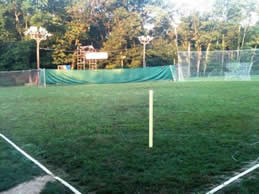
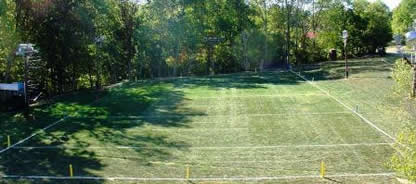
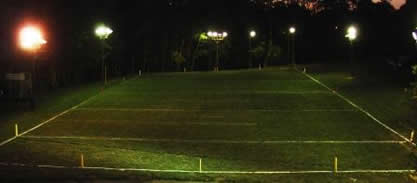
Fall is flag football time at Legends Park - the sport which started our obsession and the need for lights.
If you have a 6-8 man team and would like to play us...drop me a note or text and we will make arrangements. Our Rules
The Field
The field is 48 yards long, 28 yards wide and divided into 4 equal sections of 12 yards each End Zones are 7 yards deep each
Teams and General College rules (1 foot in bounds on receptions, extra point returns = attempt points) We generally play 6 on 6, but 7 on 7 works also (anymore makes it a little crowded and makes scoring difficult) We have plenty of extra flag belts for use If you have a favorite football - bring it. Your team will use whatever ball you like on offense (or ours if you like) Shirt tails need to be tucked in and pants that stay up even when accidentally grabbed (some things better left unseen) We play NO or incidental contact only (too much chance of getting hurt - us old guys really appreciate this rule) - Interference blocking only (blockers can shield runners - but cannot initiate contact with defense, hands or otherwise) - Blocking results in play being called dead at spot of foul (sheilders CAN NOT extend their arms or contact with hands) Flag guarding (chopping, stiff arming, pushing off, etc) is not permitted - Results in play being called dead at spot of foul Games are played to 40 points - with each team having an equal number of offensive series - In case where both teams score 40 or more - highest score wins - In case of tie - college overtime rules apply - 4 downs from midfield (no first downs possible) Touchdowns are 6 points - 1 point extra point from 5 yard line (quarterback may not run unless blitzed) - 2 point extra point from 8 yard line (quarterback may run regardless of rush or not) Fumbles are down at point where ball touches the ground (same as interception if caught in air) Interceptions may be returned Stripping the ball after possession is considered illegal contact - automatic 1st down at spot (that no contact thing) Backwards laterals are legal at anytime Only 1 forward pass is permitted per play - but it can be preceded by any number of laterals, pitches, handoffs, reverses, etc. Unlike tackle football, the ball is spotted at the point of the runner's feet and ground contact - not the ball position - if runner leaves feet (i.e., jump) and flag is pulled, the ball is spotted at the place the runner's feet last contacted ground
Kickoffs and Punts
Kickoffs are conducted from the goal line Balls may be punted or kicked from a tee Balls going out of the end zone (touchback) cause the ball to be spotted on the 25 yard line Balls going out of bounds (penalty) cause the ball to be spotted on the 50 yard line Kickoffs are treated like punts so as to minimize contact potential, i.e., balls can be "downed" by the kicking team - but not recovered (as in NO onside kicks) Interference only shielding (no contact blocking - offense MUST yield position)
If on 4th down the offense chooses to punt - The ball is placed on the opposing team's 5 yard line (we call this the Tressel rule - most important play in football)
Offense
All players are eligible to be receivers - unless both teams agree otherwise due to unequal number of players Balls may be snapped or just thrown to the quarterback The quarterback may not run unless the defense blitzes Anyone else on the team may run (but since there is no blocking this is not terribly effective) Offensive players CANNOT initiate contact - either by blocking or running into defenders on purpose The offense gets 4 plays to get a 1st down or touchdown
First downs are achieved by moving the ball 1 complete section of the field - if the ball is spotted on the 25, then midfield is the first down line - if the ball is spotted at the midfield line, then the 25 is again the first down line - a ball spotted just beyond the midfield line results in 1st down and goal
Balls are spotted at the point the runner's lead foot is when the flag is successfully pulled Balls turned over on downs results in the other team starting at the last ball spot going the opposite direction.
Defense and Rushing
Any variety of defense may be played i.e., man-to-man, zone...etc. Jamming at the line of scrimmage, or anywhere - IS NOT permitted - incidental contact only Any number of players may rush - Normal rushes occur from the closest line the first full 5 yards from the ball spot (anywhere from 5 -9 yards) - Rushes can be immediate or delayed Any number of players may Rush or BLITZ - 1 blitz permitted per series of downs (replenishes after a first down is made) - blitzes may be initiated from the line of scrimmage - The quarterback is allowed to run ONLY when the defense blitzes (or on 2 point extra point attempts) |